
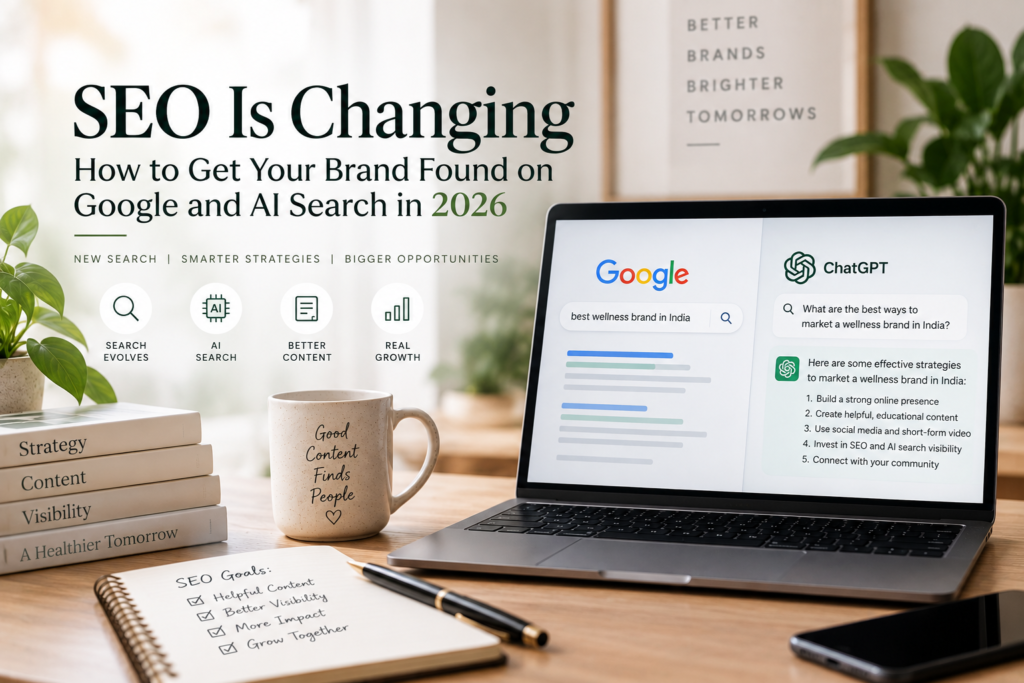
Search engine optimisation, or SEO, has always been about helping people discover your business online. But the way people search for information is changing rapidly.
Google remains an important part of online discovery, but people are also increasingly using AI-powered search and conversational tools to find answers, compare options and research businesses.
For Indian businesses, this means SEO needs to evolve.
The goal is no longer simply to rank for a handful of keywords. Brands need to create useful, trustworthy and easy-to-understand content that can serve customers wherever they search.
So, how can businesses improve their SEO strategy in 2026?
1. Focus on Questions, Not Just Keywords
Traditional SEO often starts with keywords.
For example, a yoga studio might target:
“yoga classes in Kochi”
That’s still useful.
But customers may also search for questions such as:
- How do I start yoga as a beginner?
- How often should I practise yoga?
- Is yoga suitable for older adults?
- What should I expect from my first yoga class?
Creating content around these questions allows a business to reach people at different stages of their decision-making process.
Someone searching for information today could become a customer tomorrow.
2. Create Helpful, People-First Content
One of the most important principles of modern SEO is simple:
Create content for people first.
An article shouldn’t exist simply because a keyword has search volume.
It should provide something useful.
For example, instead of writing a short article filled with the phrase “digital marketing for wellness brands” repeatedly, a better article could explain:
- What digital marketing means for wellness businesses
- Which channels are most useful
- How to create a content strategy
- How SEO can generate long-term visibility
- How social media and paid advertising can support growth
The keyword helps search engines understand the topic, but the quality and usefulness of the content should come first.
3. Build Topical Authority
Publishing one article about a subject is helpful.
Publishing a collection of high-quality articles around the same subject can be even more valuable.
This is known as building topical authority.
For example, Zenovia could create a content cluster around digital marketing for wellness brands.
One main article could explain the overall strategy.
Supporting articles could cover:
- Instagram marketing
- SEO
- Google Ads
- WhatsApp marketing
- Email marketing
- Content marketing
- AI search
- Branding
These articles can be connected using internal links.
Together, they create a stronger resource for readers.
4. Make Your Website Easy to Understand
SEO isn’t only about blog articles.
Your entire website needs to be easy for users and search engines to understand.
Make sure your pages have:
- Clear titles
- Logical headings
- Descriptive URLs
- Useful internal links
- Mobile-friendly layouts
- Fast-loading pages
- Relevant images
- Helpful page descriptions
For example, a URL such as:
zenovia.in/services
is easier to understand than a URL filled with random numbers or characters.
Small technical details can make a website much easier to navigate.
5. Think Beyond Traditional Google Search
AI-powered search is changing the search experience.
Instead of simply displaying a list of links, AI systems can provide conversational answers to detailed questions.
This means businesses should think about how their content can become a useful source of information.
This is where the concept of Generative Engine Optimization (GEO) comes in.
GEO focuses on making content easier for generative AI systems to understand and potentially reference.
The good news is that many practices that support traditional SEO also help here.
Clear writing, useful information, logical structure and demonstrated expertise are valuable for both people and search systems.
6. Use Original Information and Experience
The internet already contains millions of articles.
Simply rewriting information that already exists isn’t a strong long-term content strategy.
Businesses should try to add something original.
This could include:
- Personal experience
- Case studies
- Original research
- Customer insights
- Industry observations
- Examples
- Expert opinions
For example, instead of simply explaining that Instagram is useful for wellness brands, a marketing agency could share examples of different content strategies and explain why each one works.
That makes the content more distinctive.
7. Don’t Forget Internal Linking
Internal links connect different pages on your website.
Suppose you publish an article about:
Digital Marketing Trends in India 2026
Within that article, you could link to another article about:
SEO and AI Search
You could then link from that article to your article about:
GEO for Indian Brands
This creates a connected content ecosystem.
It also helps readers discover more information without leaving your website.
8. Optimise for Humans, Not Just Search Engines
There is a temptation to make every SEO decision based on what a search engine might prefer.
But ultimately, people are the ones who matter.
A visitor should be able to open your article and quickly understand:
What is this about?
Does it answer my question?
Can I trust this information?
What should I do next?
Use short paragraphs, descriptive headings, bullet points and clear language.
Good readability isn’t just aesthetically pleasing.
It makes information easier to consume.
What Should Businesses Do About SEO in 2026?
Don’t try to change everything overnight.
Start with the basics.
Step 1: Understand your audience
Know what your customers are searching for.
Step 2: Research their questions
Look beyond broad keywords and identify specific problems they want solved.
Step 3: Create useful content
Write articles that genuinely answer those questions.
Step 4: Connect your content
Use internal links to build topic clusters.
Step 5: Improve your website
Make sure your pages are fast, mobile-friendly and easy to navigate.
Step 6: Measure results
Monitor traffic, rankings, engagement and conversions.
SEO is a long-term process rather than a one-time activity.
Final Thoughts
SEO is changing, but its fundamental purpose hasn’t changed.
People want useful answers.
Businesses want to be discovered.
Search engines and AI systems are simply changing the way those two things connect.
For Indian businesses in 2026, the strongest approach is to combine traditional SEO fundamentals with genuinely helpful content, clear website structure, original insights and an understanding of emerging AI-powered search.
Don’t focus only on ranking number one.
Focus on becoming a valuable source of information for the people you want to reach.
Because when your content helps people, your brand becomes easier to discover, easier to trust and ultimately easier to choose.