
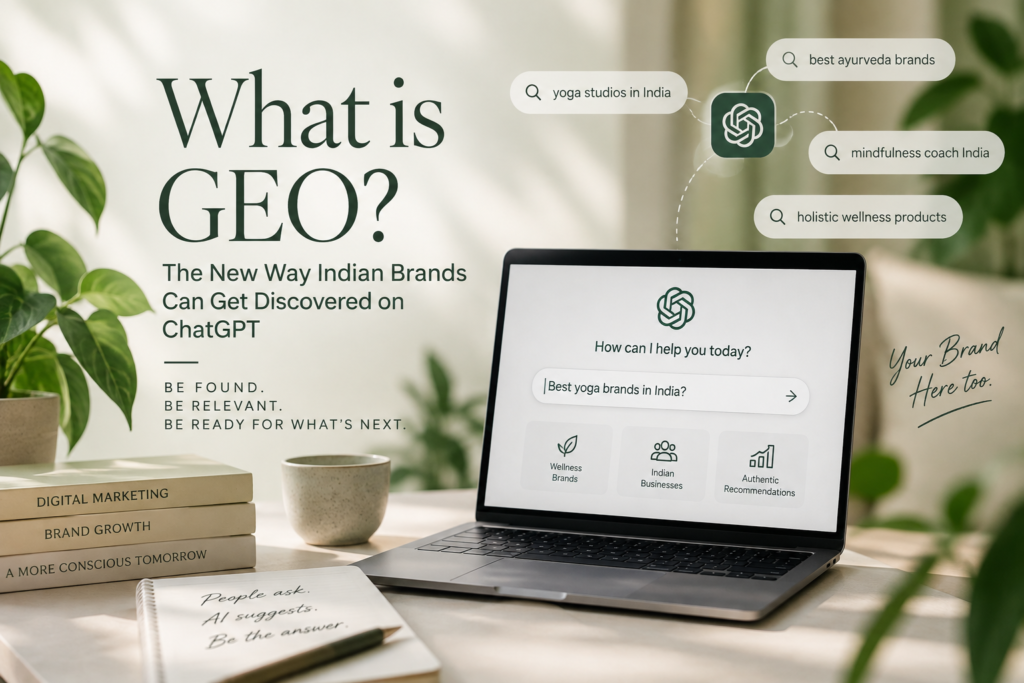
Search is changing.
For years, businesses focused on getting their websites to appear on Google when potential customers searched for relevant keywords. SEO became an essential part of digital marketing, helping businesses improve their visibility and attract organic traffic.
But today, people are increasingly using AI-powered tools to find information, compare businesses and answer questions.
Instead of searching only for a list of websites, someone might ask an AI tool a detailed question and receive a conversational answer.
This has led to growing interest in a new concept called Generative Engine Optimization, or GEO.
But what exactly is GEO, and why should Indian businesses care about it?
What Is Generative Engine Optimization?
Generative Engine Optimization (GEO) refers to the practice of creating and structuring online content so that it can be better understood and potentially surfaced or referenced by AI-powered search and answer systems.
Traditional SEO focuses primarily on improving visibility in search engine results.
GEO considers the growing role of generative AI in how people discover information.
The two approaches are not competitors.
In fact, many good SEO practices can also help content become more useful and understandable in AI-powered search.
Why Is GEO Important in 2026?
The way people discover information is becoming more conversational.
Imagine someone wants to start practising yoga.
Instead of typing:
“yoga benefits”
they might ask:
“What type of yoga is best for a beginner who wants to reduce stress?”
An AI-powered search system can understand the context of that question and provide a detailed response.
For businesses, this creates a new opportunity.
If your website contains clear, useful and trustworthy information about the questions your customers ask, your content has a better chance of being recognised as relevant.
This is particularly interesting for Indian businesses operating in competitive industries such as wellness, healthcare, education, travel, food and technology.
1. Answer Real Customer Questions
One of the simplest ways to improve your content for modern search is to answer genuine questions.
Think about the questions your customers ask before purchasing.
For a yoga studio:
“Is yoga suitable for beginners?”
For a fitness business:
“How many days a week should a beginner exercise?”
For a healthy food brand:
“What should I look for when choosing a healthy snack?”
Create useful content around these questions.
Don’t just provide a one-line answer.
Explain the subject clearly and give readers enough context to make an informed decision.
2. Create Helpful, In-Depth Content
AI-powered search needs information it can understand.
Short, vague content doesn’t give readers much value.
Instead, create comprehensive resources that genuinely explain a subject.
For example, an article about digital marketing for wellness brands could cover:
- SEO
- Social media marketing
- Content marketing
- Google Ads
- Email marketing
- WhatsApp marketing
- Brand strategy
- Measuring results
This creates a useful resource rather than a page designed simply to target a keyword.
3. Use Clear Headings and Structure
The structure of your content matters.
Break long articles into logical sections.
Use descriptive headings such as:
What Is GEO?
How Does GEO Work?
Why Does GEO Matter for Indian Businesses?
How Can Businesses Optimise Their Content?
You can also use bullet points and numbered lists where appropriate.
This makes your content easier for people to scan and easier for systems to understand.
4. Demonstrate Expertise
Trust matters online.
Businesses should clearly demonstrate that they understand the subjects they write about.
This can be done through:
- Expert-written articles
- Author information
- Case studies
- Original research
- Industry experience
- Practical examples
- Data and evidence
For example, a wellness business can share educational content based on its genuine area of expertise.
A digital marketing agency can share insights from campaigns, content strategies and marketing experiments.
The more useful and credible the information, the stronger the content becomes.
5. Add Original Insights
The internet already contains enormous amounts of information.
Simply rewriting existing articles doesn’t give readers much new value.
Businesses should try to contribute something original.
This could be:
An original case study
A unique observation
Customer insights
Your own process
Results from an experiment
Original research
For example, instead of simply saying that Reels are useful for wellness businesses, a marketing agency could explain which types of Reels tend to work for different wellness audiences and why.
That creates something more valuable than a generic article.
6. Build Topic Clusters
A single article can be useful, but multiple connected articles can create a stronger resource.
Suppose your main topic is:
Digital Marketing for Wellness Brands
You could create supporting articles about:
- SEO for wellness brands
- Instagram marketing
- Google Ads
- WhatsApp marketing
- Content marketing
- Email marketing
- AI search
- GEO
These articles can be connected using internal links.
This helps readers move naturally from one topic to another while building a deeper collection of information around your main subject.
7. Keep Traditional SEO Fundamentals
GEO doesn’t mean businesses should forget SEO.
Your website should still have:
- Clear page titles
- Relevant keywords
- Descriptive URLs
- Logical headings
- Internal links
- Mobile-friendly pages
- Fast performance
- Useful meta descriptions
- High-quality content
These fundamentals continue to provide a strong foundation for online visibility.
Think of GEO as part of a broader search strategy rather than a replacement for SEO.
8. Don’t Try to “Trick” AI
There is no guaranteed formula for getting your business mentioned by ChatGPT, Google AI or another generative search system.
Be cautious of anyone promising guaranteed AI-search placement.
Instead, focus on something you can control:
Create genuinely useful information.
The goal isn’t to manipulate an AI system.
The goal is to make your business a credible source of information within your area of expertise.
GEO for Indian Businesses
Indian businesses have a particularly interesting opportunity because the country’s online audience is diverse.
Businesses can create content around specific locations, industries, customer needs and languages.
For example, a wellness business in Kerala could create useful content around wellness services available in Kerala while also answering common questions from local customers.
A national wellness brand could create content addressing the needs of customers across different regions of India.
The more relevant the content is to a specific audience, the more useful it becomes.
GEO and the Future of Search
Search is likely to become increasingly conversational.
People may use traditional search engines, AI assistants, social platforms and other discovery tools depending on what they need.
This means businesses shouldn’t build their entire digital marketing strategy around a single platform.
Instead, they should build a strong online presence supported by:
Good SEO + Helpful Content + Strong Branding + Genuine Expertise
GEO is simply another piece of this evolving search landscape.
Final Thoughts
Generative Engine Optimization is an emerging area of digital marketing, but its underlying principle is surprisingly simple.
Be useful. Be clear. Be trustworthy.
Create content that answers real questions.
Explain subjects thoroughly.
Share original insights.
Make your website easy to understand.
And continue following strong SEO fundamentals.
You cannot guarantee that an AI system will mention your business.
But you can make your website a valuable source of information for the people you want to reach.
And in a world where search is becoming more conversational, being genuinely useful may be one of the strongest marketing strategies of all.