
For a business trying to grow online, one question comes up again and again:
Should you spend your advertising budget on Google Ads or Instagram Ads?
There isn’t one universal answer.
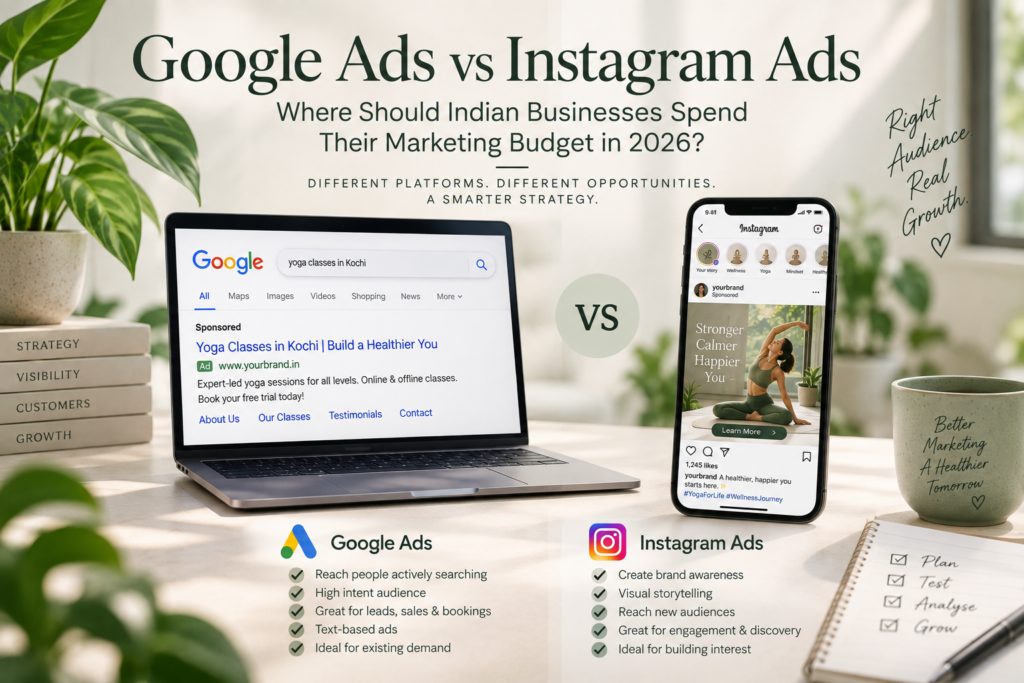
The two platforms work differently because they reach people at different stages of the customer journey. Google can help businesses reach people who are actively searching for a product or service, while Instagram can help brands create awareness and interest through visual content.
Understanding this difference is more useful than simply asking which platform is better.
Google Ads: Capture Existing Demand
Imagine someone searches:
“Yoga classes in Kochi”
or
“Wellness coach in India.”
They already have a need or interest.
Google Search Ads allow businesses to appear when people are searching for relevant products and services. This makes Google particularly useful when there is already demand for what your business offers.
Google Ads can be useful for:
- Local services
- Professional services
- High-intent products
- Lead generation
- Online bookings
- E-commerce
- Businesses with strong search demand
Google Ads also provides campaign and bidding options designed around different objectives, including clicks, leads, sales and conversions.
Instagram Ads: Create Discovery and Interest
Instagram works differently.
People don’t necessarily open Instagram because they are searching for a particular business. They may discover a brand while watching Reels, browsing posts or exploring content.
A well-designed advertisement can introduce someone to a business they didn’t previously know existed.
For example, a wellness brand could show a short Reel demonstrating a simple yoga routine.
Someone discovers the Reel → visits the profile → explores the content → visits the website → eventually books a session.
Instagram can therefore be useful for visual storytelling, discovery, engagement and building brand awareness.
The Biggest Difference: Intent
One of the simplest ways to understand the difference is through customer intent.
“I am looking for something.”
“This looks interesting.”
Neither behaviour is automatically better. They simply represent different points in the customer journey.
Google Ads vs Instagram Ads
| Factor | Google Ads | Instagram Ads |
|---|---|---|
| Main strength | Capturing search demand | Creating discovery |
| User behaviour | Actively searching | Browsing content |
| Main formats | Search ads | Reels, images, Stories |
| Targeting | Keywords and audiences | Audiences and Meta signals |
| Strong use case | Leads, sales, bookings | Discovery and awareness |
| Creative requirement | Strong copy and relevance | Strong visual content |
| Landing destination | Website, call or booking page | Website, profile or landing page |
The actual results will depend on your industry, audience, competition, creative, landing page, tracking and campaign strategy.
What About Advertising Costs?
Many businesses ask:
“Which one is cheaper?”
There isn’t a universal answer.
Advertising costs can change depending on:
- Industry
- Location
- Competition
- Audience
- Campaign objective
- Ad quality
- Landing page
- Seasonality
- Conversion rate
- Bidding strategy
Instead of comparing only the cost of a click, businesses should look at the cost of acquiring a valuable customer.
For example, an inexpensive click isn’t particularly useful if it never turns into an enquiry or purchase.
Don’t Judge Campaigns Only by Clicks
Clicks, impressions, likes and views can tell you what is happening at the top of the funnel, but they don’t necessarily tell you whether the campaign is generating business.
Consider two campaigns:
Campaign A
1,000 clicks → 5 customers
Campaign B
500 clicks → 15 customers
Campaign B generated fewer clicks but more customers.
This is why conversion tracking and meaningful business metrics are important.
Depending on your business, you may want to track:
- Leads
- Sales
- Bookings
- Cost per lead
- Cost per acquisition
- Conversion rate
- Revenue
- ROAS
When Google Ads May Make Sense
Google Search can be particularly useful when customers already search for your type of product or service.
For example:
- “Yoga classes near me”
- “Online meditation classes”
- “Digital marketing agency Kochi”
- “Healthy snacks online”
- “Fitness trainer near me”
If people are actively looking for what you provide, Search Ads can help your business compete for that existing demand.
When Instagram Ads May Make Sense
Instagram can be particularly useful when your business benefits from visual content and brand discovery.
For example:
Wellness brands
Show the lifestyle and philosophy behind the brand.
Fitness businesses
Demonstrate exercises and useful tips.
Yoga teachers
Share short educational videos.
Healthy food brands
Show products, recipes and preparation.
Lifestyle brands
Use visual storytelling to demonstrate products and experiences.
What If Your Brand Is New?
A new business may have very little existing search demand.
If you’ve launched a new wellness product, for example, very few people may already be searching for your brand.
Instagram advertising and content can help introduce the brand to potential customers who may not have been actively searching for it.
As awareness develops, customers may later search for your brand or products directly.
What If People Are Already Searching for You?
Now consider an established yoga studio in Bangalore.
Potential customers might already search for:
“Yoga classes in Bangalore”
or
“Yoga classes near me.”
In this situation, Google Search can provide an opportunity to reach people who have already demonstrated interest.
This is one of the fundamental differences between capturing demand and creating discovery.
You Don’t Always Have to Choose One
Google Ads and Instagram Ads can also work together.
A potential customer might:
See an Instagram Reel
↓
Visit your website
↓
Leave without enquiring
↓
Search for your brand later
↓
Click a Google Ad
↓
Book a consultation
Looking only at the final click may not show the complete customer journey.
For some businesses, combining awareness, consideration and conversion activities can create a more connected advertising strategy.
A Simple Strategy for Indian Businesses
Before deciding where to spend your budget, ask yourself:
1. Are people actively searching for my product?
Consider Google Search.
2. Is my product highly visual?
Instagram may offer strong discovery opportunities.
3. Do I need leads or bookings?
Consider where your potential customers demonstrate the strongest intent.
4. Do I need to build awareness?
Social advertising can help introduce your brand to new audiences.
5. Can I create strong video content?
Instagram gives businesses an environment to test visual creative.
6. Can I track conversions?
Make sure important actions such as enquiries, purchases and bookings are measured.
Final Thoughts
Google Ads and Instagram Ads aren’t simply two versions of the same advertising platform.
Google can help businesses respond to existing search intent.
Instagram can help businesses create discovery and interest through visual content.
For some businesses, Google may be an important acquisition channel. For others, Instagram may play a larger role in awareness and discovery. Some businesses may benefit from using both.
The right advertising strategy starts with understanding your customer, your objective and your conversion journey.
Don’t begin with:
“Which platform should I choose?”
Begin with:
“Where does my customer make decisions, and what do I need my advertising to achieve?”
Then use your campaign data to guide your next decision.